


Support for stress and regulation
Trials of breathing practices offer encouraging findings for perceived stress, anxiety and mood. The results depend on the technique and study design.
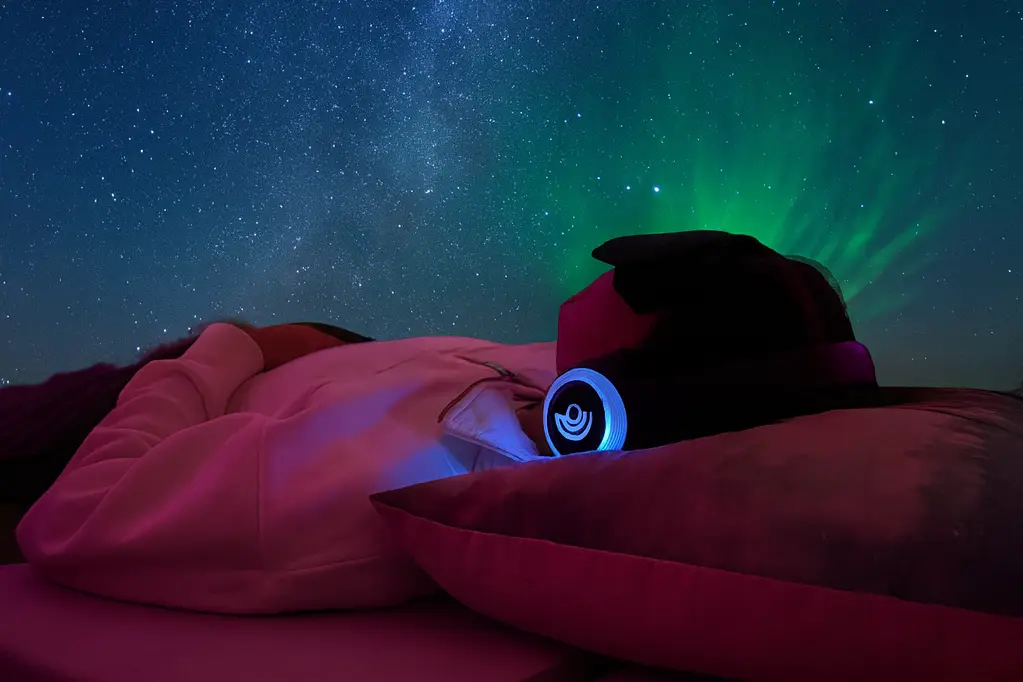
A guided, body-based experience alongside therapy. Explore how 9D sessions work, what clients can bring back into your care and the research informing a referral.
9D is a branded, facilitated breathwork format. Participants lie down, wear headphones and follow breathing instructions within a recorded audio journey, with me present to guide the session.
Breathing rate and depth influence autonomic activity and carbon dioxide levels. Slow breathing and high-ventilation breathing have different physiological effects; they should not be treated as interchangeable techniques.
Slow-breathing research reports changes in heart-rate variability and respiratory sinus arrhythmia: the normal variation in heart rate with the breathing cycle. Studies also report relaxation. These findings help explain the regulation-first approach, without establishing a lasting “reset” of the nervous system.
Connected breathing can increase ventilation. In a 2025 study of circular breathwork, lower end-tidal CO₂ was associated with altered subjective experience. This is a physiological observation, not proof that sensations or emotional intensity represent trauma being released.
Attention to rhythm and regulation
The recording combines music, spoken prompts and layered sound, including binaural-beat and frequency-based elements. It gives the participant instructions and an auditory focus. Evidence about breathing alone does not establish the added clinical effect of these audio components.
Preparation, suitability discussion, breathing guidance and support during the experience. At Kora, slower nasal breathing comes first; activating exploration depends on the agreed format and readiness. Reflection afterwards can be taken into the client’s ongoing therapy.
Zaccaro et al. (2018): review of slow breathing in healthy participants. Havenith et al. (2025): circular-breathwork study involving experienced practitioners. Neither tests the complete 9D format.
These are the main reasons to consider a referral. Research findings, personal experiences and the support provided in a session each contribute a different part of the picture.
Trials of breathing practices offer encouraging findings for perceived stress, anxiety and mood. The results depend on the technique and study design.
Clients can attend to physical sensations and feelings without explaining them as they arise. Some describe relief, clarity or relaxation afterwards.
The client may bring observations back to you for discussion and interpretation. I facilitate the experience; ongoing therapeutic processing stays within your care.
Responses vary; the list does not establish every benefit for the complete 9D format.
I guide your client through breathing and make space for any feelings or sensations that come up, without asking them to explain their story. Afterwards, they can bring anything they want to explore further into their sessions with you.
The concerns below may be familiar from your work with clients. Each explains how breathwork could offer support alongside therapy. Before a referral, we can talk about your client’s needs and whether a session would be suitable.
Slower, guided breathing may help ease the physical arousal that accompanies stress, giving your client a way to practise moving from feeling on edge towards relaxation. Trials of breathing practices have found reductions in self-reported stress and anxiety, although results vary by technique.
In a session, I guide attention to breathing and physical sensations so your client can notice how they respond. This offers a practical experience of regulation alongside the work you do together.
When feelings are difficult to access or describe, guided breathing offers a way to begin with physical sensations rather than words. I make space for your client to notice what is present, without expecting a strong emotion or a particular response.
Breathing research suggests possible benefits for mood and depressive symptoms, but it does not establish 9D as a treatment for depression. The session can offer observations your client may want to explore further in therapy.
For a client who feels persistently on alert, the aim of gentler breathing is to support regulation and attention to the present moment. I guide the breathing experience without asking them to recount traumatic events or interpret what comes up.
We discuss readiness, dissociation and current support before deciding whether to proceed. Activating breathing can intensify sensations and may be unsuitable; any experience your client wants to process can return to their work with you.
Breathwork offers time to notice the physical and emotional experience of grief without needing to explain it. Gentle breathing provides a focus while I make room for sadness, tension or whatever is present, without pushing for release or resolution.
Your client can bring any feelings or observations they want to explore back into grief counselling or therapy. The support is space for their experience, rather than a promise to shorten or resolve grief.
Where stress and difficult feelings are part of a client’s recovery work, guided breathing offers a way to practise relaxation and notice physical responses alongside their existing support. The aim is to support their experience of stress, rather than treat the addiction itself.
We would agree how a session fits with their recovery plan and current stability. Breathwork is not withdrawal care, and evidence for stress relief does not establish that 9D prevents relapse.
A session gives your client opportunities to notice their own responses and make choices about participation. I respect their preferences and boundaries, so there is no expectation to produce a particular emotion or have the same experience as someone else.
These moments of noticing and choosing can become useful material for conversations about needs, boundaries and self-trust in therapy. They are opportunities for reflection, rather than a guaranteed change in self-esteem.
When feeling keyed up makes it difficult to rest, slower breathing may support relaxation. A gentler session provides time to notice breathing and tension while resting, without the demands of an activating journey.
Some clients describe sleeping well afterwards, but this is individual experience rather than evidence that 9D treats insomnia. Persistent sleep difficulties still need assessment alongside any relaxation support.
Your client can notice fear, tension or other feelings during guided breathing without having to disclose the story behind them. I offer a non-judgemental space for that experience, without assigning meaning to a sensation or asking them to explain it.
What they notice may give them a starting point for discussing difficult emotions or familiar patterns with you. Understanding those patterns and working through them remains part of their therapy.
Kora provides complementary wellbeing support, not diagnosis, crisis intervention or psychological treatment. The proposed format and suitability are discussed before booking.
The evidence gives a reason to explore breathwork for stress and emotional wellbeing. It does not yet establish outcomes for the complete branded 9D format.
Open a paper for its result, limitations and original source. Both positive and comparison findings are included.
12 stress trials · 785 adults
The pooled stress result favoured breathwork over controls, with a small-to-medium effect (Hedges’ g −0.35; 95% CI −0.55 to −0.14).
Scope and limitations. Most studies had moderate risk of bias. Protocols varied; this average is not a prediction for an individual or a result for 9D.
Effect of breathwork on stress and mental health: A meta-analysis of randomised-controlled trials
Scientific Reports, 13:432
98 student paramedics · 12 weeks
A twice-daily slow-breathing program reported lower stress, anxiety and depression, and greater resilience than the control. Insomnia and psychological wellbeing did not significantly improve.
Scope and limitations. Different dropout rates between groups reduce confidence in the findings. This Australian student sample and repeated slow-breathing practice do not establish outcomes for a single 9D session.
Examining the Effectiveness of Breathwork to Improve Resilience and Psychological Wellbeing While Reducing Anxiety, Depression, Stress, and Insomnia in Paramedicine Students: A Single-Blind Randomised Controlled Trial
Stress and Health, 42:e70161
107 adults · six weekly sessions
Participants offered six 90-minute online conscious connected breathwork sessions reported a greater reduction in anxiety than participants on a waiting list.
Scope and limitations. A waiting list does not control for facilitator attention or expectations. The sample was predominantly women and white participants; the study did not test 9D or whether breathwork improves psychotherapy outcomes.
Efficacy of online conscious connected breathwork in reducing symptoms of anxiety: A randomized waitlist control trial
Journal of Affective Disorders, 394:120565
6 trials · 517 patients
Yogic breathing showed a small short-term improvement in symptom severity compared with passive controls in people with diagnosed mental disorders. There was no clear advantage over standard care.
Scope and limitations. Four of six trials had high risk of bias. Safety reporting was limited, with adverse events more often linked to fast breathing. These findings do not establish equivalence to therapy or benefits for 9D.
Effectiveness of pranayama for mental disorders: a systematic review and meta-analysis of randomized controlled trials
Frontiers in Psychiatry, 16:1616996
48 mental health professionals
After experiencing high-ventilation breathwork, mental health professionals reported altered states and rated its potential clinical use and risks. The authors called for controlled clinical trials.
Scope and limitations. This measured professional perceptions, not patient recovery or treatment effectiveness. It supports further investigation, not a claim that intense experiences release trauma or improve therapy.
High ventilation breathwork as a non-pharmacological model for inducing psychedelic-like states: expert evaluations of therapeutic potential and risk
npj Mental Health Research, 5:48
200 adults · three weeks
Daily high-ventilation breathing with breath holds did not improve stress more than a matched breathing comparison. Other measured mental health and wellbeing outcomes also showed no advantage.
Scope and limitations. This was a remote practice in young, healthy adults. It questions claims that more activating breathing necessarily produces greater benefit; it does not test facilitated 9D sessions.
Effects of brief remote high ventilation breathwork with retention on mental health and wellbeing: a randomised placebo-controlled trial
Scientific Reports, 14:16893
5 min daily practice for one month
Breathwork, particularly exhale-focused cyclic sighing, improved mood and reduced respiratory rate more than the mindfulness comparison.
Scope and limitations. These were brief daily exercises. Cyclic sighing is not equivalent to activating 9D breathwork, and the trial did not test Kora’s sessions.
Brief structured respiration practices enhance mood and reduce physiological arousal
Cell Reports Medicine, 4:100895
15 studies of slow breathing
In healthy participants, slow breathing was associated with changes in heart-rate variability and reports of relaxation.
Scope and limitations. This review explored mechanisms in healthy people. It does not establish a treatment effect or test activating 9D sessions.
How Breath-Control Can Change Your Life: A Systematic Review on Psycho-Physiological Correlates of Slow Breathing
Frontiers in Human Neuroscience, 12:353
From Kora’s Google review records. These describe individual experiences, rather than measured treatment outcomes.
“I left the session feeling lighter, more relaxed and slept soundly.”
“I've had several breathwork sessions with Kora Wellness and every time I leave lighter and with clarity.”
“Where others might have hesitated or discouraged me, these women were so supportive and accommodating. I felt safe, seen, and genuinely welcomed. They held space beautifully, and the atmosphere was one of non-judgment, encouragement, and deep care.”
“I came open minded not knowing what to expect and it turned out to be a powerful yet calming and emotional experience for me.”
There’s no pressure to make a referral. Start with an honest conversation about your client or practice, ask questions and get to know how I work. Email your name, organisation and a suitable time to talk, or call directly.