


Two breathing approaches
I use slower nasal breathing for down-regulating journeys and conscious connected breathing for activating journeys. We choose the approach together, and I show you how to adjust it.
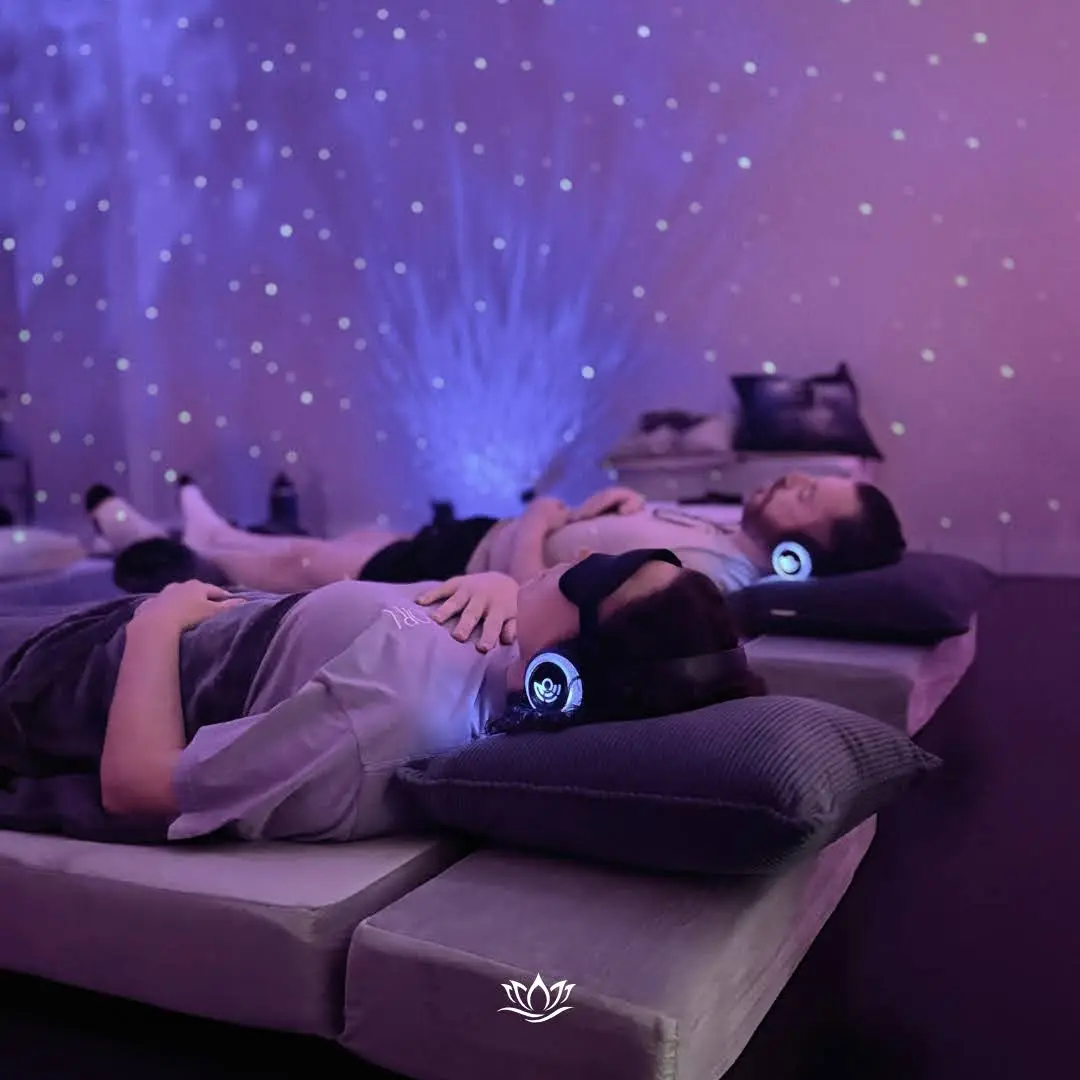
Put on your headphones, get comfortable, and I’ll guide you into the breathing. 9D brings together breathwork, immersive sound and hypnotic coaching, giving you time to step away from everyday demands and pay attention to what you’re carrying.
In a 9D session, your breathing follows a recorded journey that unfolds through headphones. As you settle onto the mat, the narration helps you find your rhythm and draws your attention into the experience. Music and sound move around you, while visualisations and spoken prompts explore a theme such as letting go or self-belief.
That recording brings together binaural beats, solfeggio frequencies and pulsing tones with hypnosis and neuro-linguistic programming (NLP). They sit within the story you are following, so you can spend your time noticing what comes up rather than trying to remember a breathing exercise. The guidance invites you to explore familiar reactions and beliefs as the journey progresses.
How we breathe shapes that experience. A slower nasal rhythm gives us a way to settle; an activating journey uses conscious connected breathing and can feel more emotionally and physically intense. Before we start, we talk about what brings you here and choose an approach that suits you. I stay with you throughout, paying attention to how you are responding and helping you adjust when needed.
I use slower nasal breathing for down-regulating journeys and conscious connected breathing for activating journeys. We choose the approach together, and I show you how to adjust it.
Spatial audio, binaural beats and carefully chosen frequencies sit alongside hypnotic suggestions and coaching.
I stay present throughout, observing breathing and responses and attending to the safety of the room. I can help you change pace, return to your usual breathing or pause when you need support.
“9D” names the combination of nine elements used in the experience. Some shape the sound you hear, others guide your breathing or invite reflection. They are woven into the same journey: you might follow a voice through a visualisation while the music changes around you and your breathing shifts. Understanding each element helps make sense of what you are listening to and why it is included.
Voices, music and effects are placed across the left and right audio channels, so they can seem to move around you or come from different distances.
That changing sense of space makes the recording feel more immersive. With your eyes closed, you can follow the sound and imagery without needing something to look at.
Each ear hears a slightly different steady tone. Your auditory system perceives a beat at the difference between them, rather than hearing two unrelated notes.
Beat frequencies include ranges associated with theta (around 4–8 Hz) and gamma (above 30 Hz) brain activity. They are used with the intention of supporting relaxation and awareness as the journey unfolds.
These are named pitches used in sound practices, commonly including 396, 417, 528, 639, 741 and 852 Hz. Hz means vibrations per second: it tells you the pitch of a tone.
Different journeys use different frequencies to suit their purpose. Selected tones are woven into the music to shape the emotional atmosphere, from quieter passages for settling to more expansive moments of exploration.
A tone turns on and off at evenly spaced intervals, creating an audible pulse. Unlike a binaural beat, that pulse is physically present in the recording and can be heard through either ear.
The repetition adds a steady rhythm beneath the journey, used with the aim of supporting focused or restful attention.
This describes how the music is tuned: the reference note A is set to 432 Hz rather than the common 440 Hz. The other notes are tuned in relation to it, making the music slightly lower in pitch.
Solfeggio refers to selected individual tones; 432 Hz tuning applies to the musical scale. In 9D, it contributes to the overall listening atmosphere. It does not mean every sound in the recording is 432 Hz.
Somatic simply means relating to the body. Here, you work with breathing while noticing physical experience: a clenched jaw, movement through your ribs, or shoulders that soften as you settle.
I invite you to notice those sensations alongside any emotions that arise. You do not have to analyse everything or find the right words while you are breathing; we can talk about your experience afterwards.
9D uses this name for quieter suggestions mixed beneath the main narration and music. They are intended to reinforce the journey’s theme, such as self-belief or letting go, without being the voice you consciously follow.
A narrator carries you through the journey, from settling in to exploring its theme and returning to rest. In active journeys, that includes cues to change your breathing as the music and emotional intensity build.
Visualisations, affirmations, hypnotic language and NLP prompts invite you to explore familiar beliefs and imagine different responses. You have a voice to follow through that process, with me facilitating in the room.
9D uses this term for low-frequency sound effects that give the recording depth and resonance. These sounds can make a passage feel fuller and more enveloping as the journey builds or settles.
Alongside the narrator and music, this deeper sound helps shape the intensity and atmosphere of a passage.
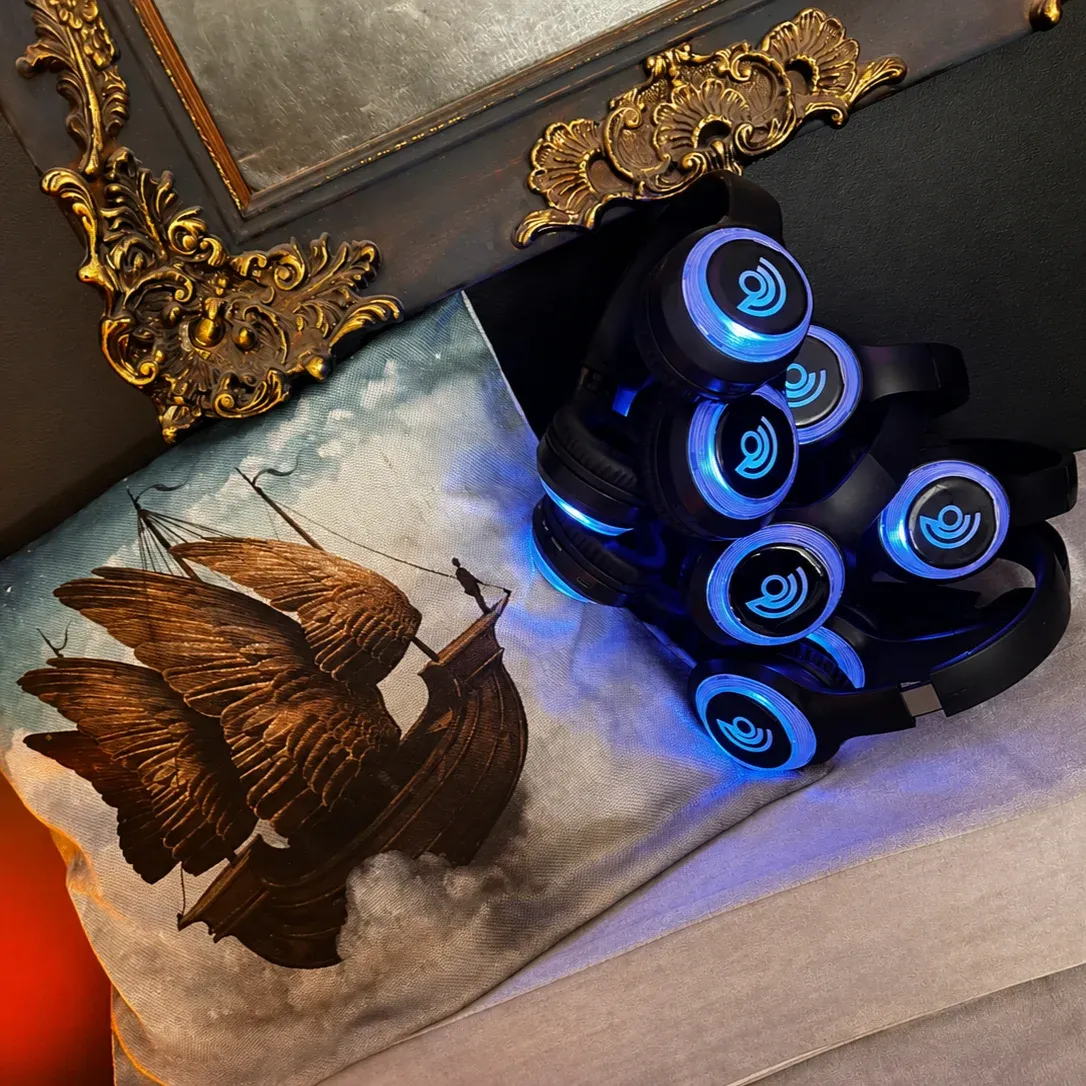
For a binaural beat to form, your ears need to receive different tones. Headphones keep the left and right signals separate; through room speakers, both ears would hear a mixture. That separation also lets the recording position a voice or sound to one side, then move it across your listening space.
Two breathing approaches shape the pace of a 9D journey: slower nasal breathing for settling, and conscious connected breathing for a more active experience.
Conscious connected breathing describes a breathing pattern. Holotropic Breathwork is a specific approach with its own facilitation, music and integration practices, so the names are not interchangeable. Compare the approaches below.
A recorded voice carries the journey from settling in to exploration and rest. Along the way, imagery and language give you something to work with: a scene to picture, a belief to consider or a different way of speaking to yourself.
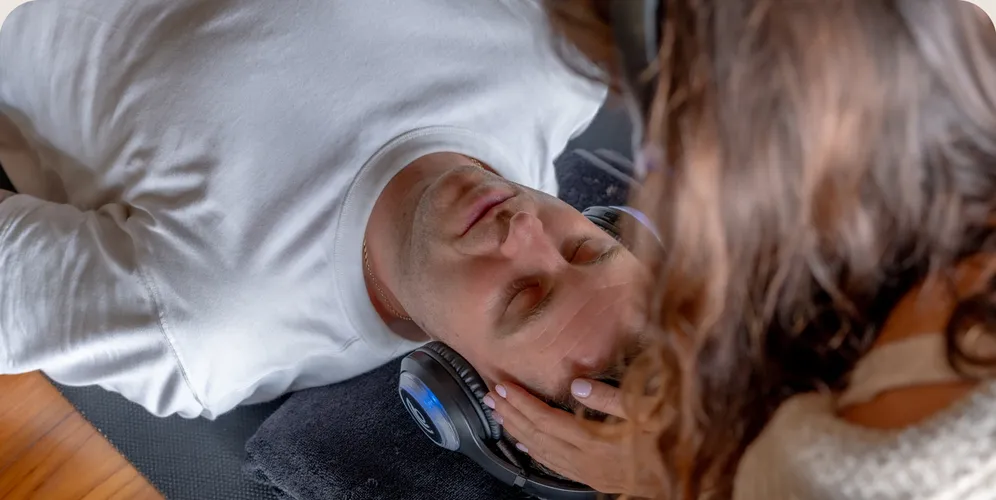
Gentle cues introduce the rhythm and help you become familiar with the experience.
As the breathing becomes more active, visualisations and prompts develop alongside the music.
The pace eases, with time to notice what came up and return your attention to the room.
Breathwork approaches differ in their purpose, breathing patterns and use of sound. Buteyko focuses on everyday breathing habits, while Wim Hof breathing uses rounds of deeper breaths and holds. Compare these with yogic pranayama, Holotropic Breathwork and 9D below.
Included Not a standard featureWritten notes explain where practices vary.
Swipe across to compare all five approaches.
| Feature | Yogic pranayama | Buteyko | Wim Hof breathing | Holotropic Breathwork | 9D breathwork |
|---|---|---|---|---|---|
| Main focus | Breath regulation within yoga | Everyday breathing habits | Breathing rounds and retention | Experiential exploration | Breath, immersive audio and coaching |
| Nasal breathing | Common | Yes — central to the practice | Nose or mouth | No fixed pattern | Yes — down-regulating journeys |
| Breathing rhythm | Varies by technique | Gentle, reduced-volume breathing | Deeper breaths followed by holds | Deeper, faster; develops freely | Slow nasal or conscious connected |
| Music shapes the journey | Optional | Not standard | Optional | Yes | Yes |
| Spatial headphone audio | Not standard | Not standard | Not standard | Not standard | Yes |
| Binaural and isochronic layers | Not standard | Not standard | Not standard | Not standard | Yes |
| Solfeggio tones and 432 Hz tuning | Not standard | Not standard | Not standard | Not standard | Yes |
| Recorded hypnosis and NLP | Not standard | Not standard | Not standard | Not standard | Yes |
| How it is practised | Taught or self-practised | Learned exercises and daily practice | Guided or self-practised | Facilitator and sitter roles | Facilitated sessions or recordings |
“Not standard” means a feature is not central to that approach; individual teachers may include it. This compares the breathing practice within the Wim Hof Method, which also includes cold exposure and mindset. Holotropic Breathwork follows its own facilitation and integration process.
Approach references: Buteyko · Wim Hof Method · Yogic pranayama · Holotropic Breathwork · Connected breathing · 9D
There’s time to get familiar with the breathing before the audio starts, and time to settle afterwards. I’ll talk you through each stage, from arriving at the studio to sharing tea afterwards.
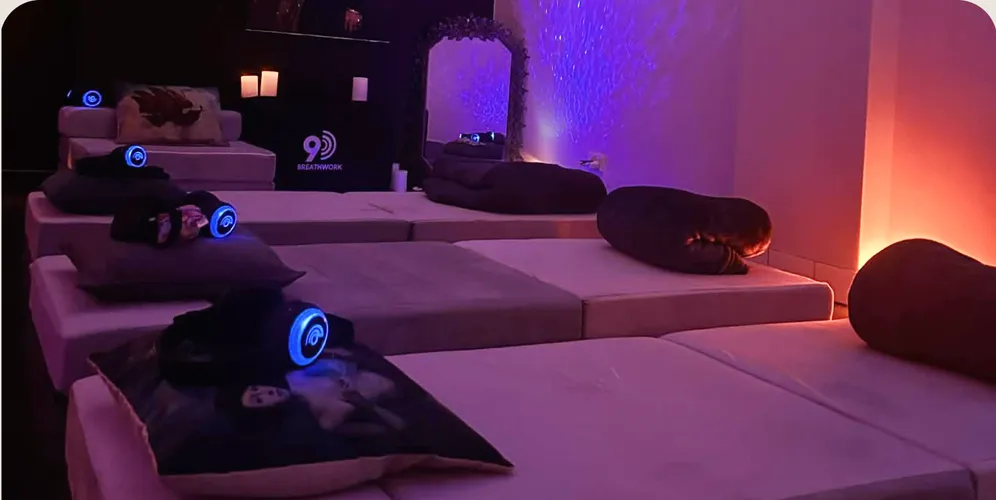
We talk about what to expect and the theme of the journey. I show you the breathing pattern, answer your questions and help you get comfortable on the mat.
With your headphones on, you follow the music and breathing cues. I stay nearby, and you can return to your usual breathing or ask for support at any point.
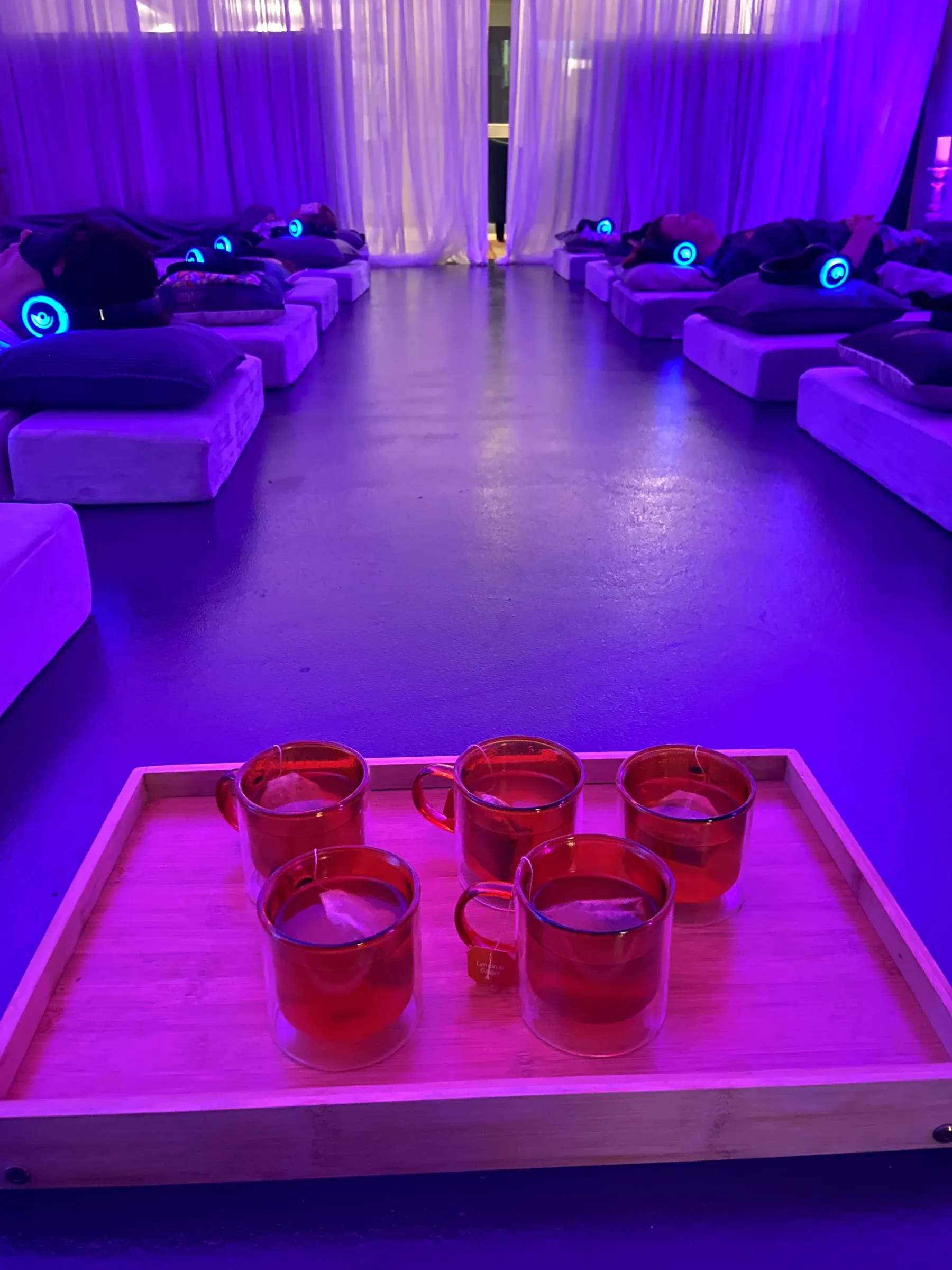
We finish with a cup of lemon and ginger tea and time to settle. You can talk with me about what came up, listen to others, or sit quietly before heading back into your day.
You might be carrying something difficult, trying to understand a familiar pattern or simply curious about the experience. These are starting points for a conversation with me; we choose the breathing approach around you.
You keep meeting everyone’s needs while your own energy runs low. I make space for slower breathing and rest, without another task to get right.
Breathwork for burnoutWorry follows you into the quiet moments. Breathing cues and spoken guidance give you a focus while I support you with the pace.
Breathwork for anxietyLife can feel flat even while you are going through the motions. A private session gives us time to explore what you are feeling, without needing a polished explanation.
Breathwork and low moodA loss, separation or change in your role can leave you unsure where to put your feelings. We can talk about a gentle starting point and make room for what you are carrying.
You finally have time to rest, yet still feel switched on. A down-regulating journey offers a place to practise slowing your breathing and giving your attention a break.
You recognise the criticism or habits that keep returning. A themed journey uses reflection and imagery to explore how you relate to yourself and what you would like to change.
Tension, restlessness or feeling shut down can make it hard to feel at ease. I work with your response as we explore a breathing pace that feels manageable.
Breathwork and your nervous systemYou may be looking for a supported way to practise being with difficult feelings during addiction recovery. We discuss suitability and how a session could fit alongside your existing support.
Breathwork in recoveryYou do not need to be in crisis to come. You might want to experience guided breathwork, make time for reflection or explore something beyond your usual meditation practice.
Research helps me explain what we know, and where an intended effect is still being investigated. Studies of breathing, music or individual tones answer different questions from a study of a complete 9D session.
Explore breathwork researchA 2023 review found a small-to-medium average reduction in self-reported stress across breathing trials. A separate trial found that slow coherent breathing did not outperform its matched breathing comparison. Technique and study design matter when interpreting a result.
A systematic review found inconsistent evidence that binaural beats entrain brainwaves. Small studies have also explored 432 Hz tuning, but they do not establish a unique healing effect or the benefits of a full 9D journey. I describe the audio’s intended role without promising that a frequency will reset your nervous system or change a belief.
“I came open minded not knowing what to expect and it turned out to be a powerful yet calming and emotional experience for me.”
“I went in as a sceptic and came out feeling very different. Wish I'd known about this years ago. After years of MMA and boxing trying to fight demons I never would have believed something like this would be the key to opening up some locked doors.”
“It was my first ever introduction to breath work and I feel as though I got a lot out of it. The delicious cup of tea and a yarning reflection was certainly a beautiful way to wrap up the session.”
“I've done some breathwork before but the 9D experience takes it to a whole other level, like it's a really powerful experience. I've done a few sessions and each time had a different experience and worked through different emotions, some that I didn't even realise needed working on and releasing.”
Yes, you can come to me without previous breathwork experience. We begin with a conversation about your health and what brings you here, then I explain the breathing and give you time to practise. Suitability depends on the person and the breathing approach; tell me about any health conditions, pregnancy or previous difficulty with breathwork before booking. I may ask you to seek advice from your healthcare professional.
You may notice the music holding your attention, changes in how your body feels, or emotions surfacing as you breathe. Some people describe deep rest; others find a session emotional. Experiences can differ from one appointment to the next. If you feel dizzy, uncomfortable or overwhelmed, return to your usual breathing and let me know so I can support you.
Most sessions run for 60–90 minutes, with the duration depending on the journey and format. There’s time for preparation and settling afterwards. Check the duration on your chosen event or service page when planning your visit.
Wear comfortable clothing that lets you breathe and lie down easily. Read the preparation information for your booking and bring any questions with you. I provide the headphones and a place to rest; we’ll go through the breathing together before the recording begins.
The price depends on whether you choose a group event, a private session or a program. Group event prices are shown with their dates on the bookings page. Private appointments and the four- and eight-week programs have their own service pages with the relevant details.
There are guided 9D recordings for home use. Choosing a suitable recording and understanding its breathing instructions matter, especially with more active journeys. A recording provides audio guidance but cannot respond to you in the way I can during a facilitated session. My at-home guide covers the differences and what to consider before starting.
Each person listens through their own headphones, which can help keep attention on the recording. You still share a room with other participants. If having the space to yourself matters to you, a private 1:1 appointment gives us that setting.
My studio is at 43 Wentworth Street, Port Kembla NSW 2505. I welcome people from Wollongong and across the Illawarra for private sessions and programs. Group events are listed on the bookings page; check the venue shown on your chosen event, as some take place elsewhere.
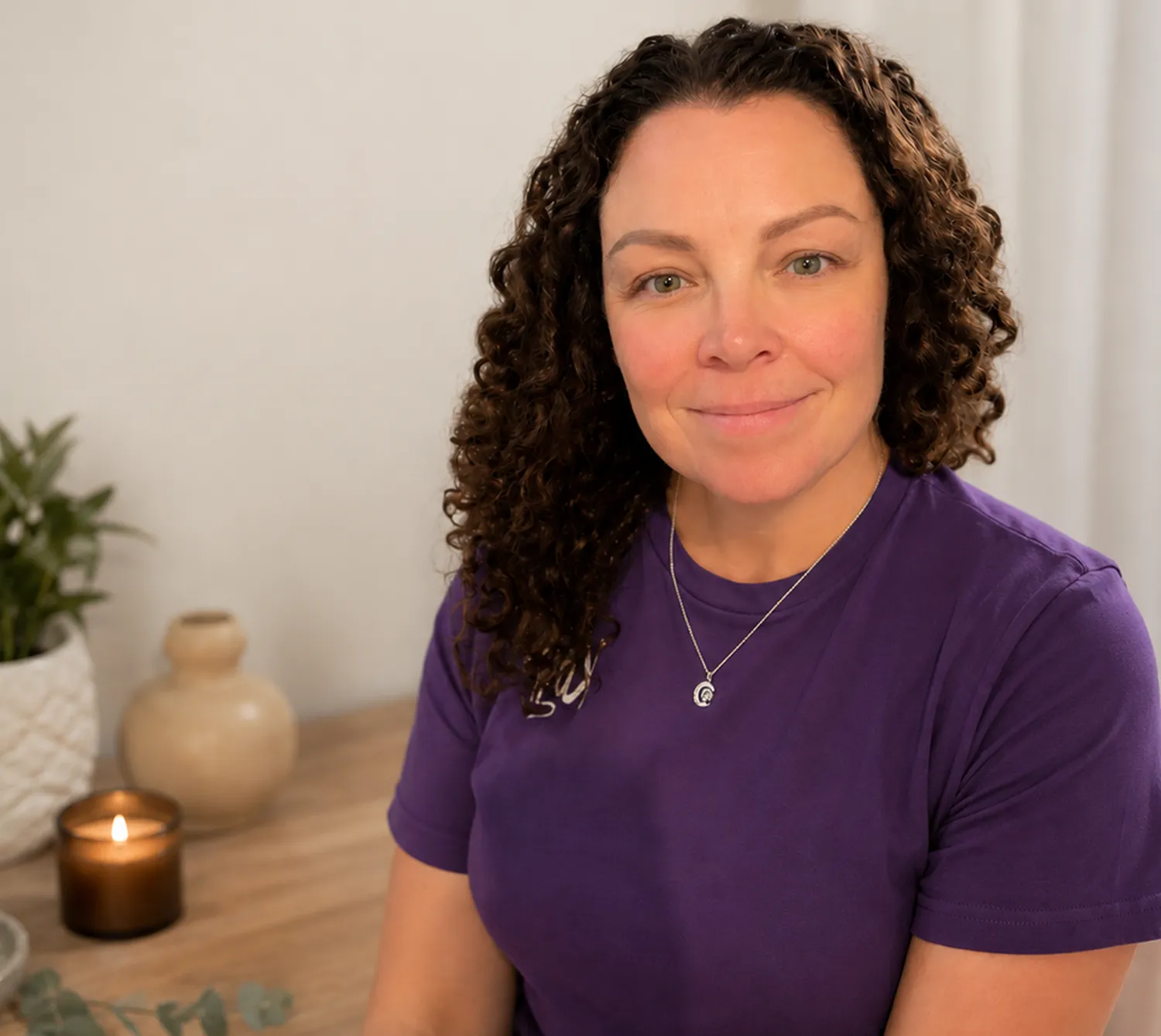
My studio is at 43 Wentworth Street, Port Kembla, near Wollongong. You can join a group event, book a private appointment or explore a program with support over several weeks.
Explore the different sessions to see what each involves and find a starting point that feels right for you.
Explore sessions and programs